Finding your meal-kit match
Helping prospective users feel confident that HelloFresh fits their lifestyle and dietary needs
B2C subscription product | Multi-market | High-traffic acquisition funnel | Growth & Personalization | Experimentation | Product fit
Context. Personalization & Growth at HelloFresh, using early user signals to drive both acquisition and long-term product engagement
Business goal. Reduce early-stage drop-offs while protecting retention
Scope. End-to-end redesign of the pre-sign-up plan selection experience
My role. Led UX strategy, prototyping, UX/UI design, and A/B testing in collaboration with product, engineering, and research
Outcome. Introduced confidence-building preference signals that improved plan selection completion and contributed €53M+ incremental revenue
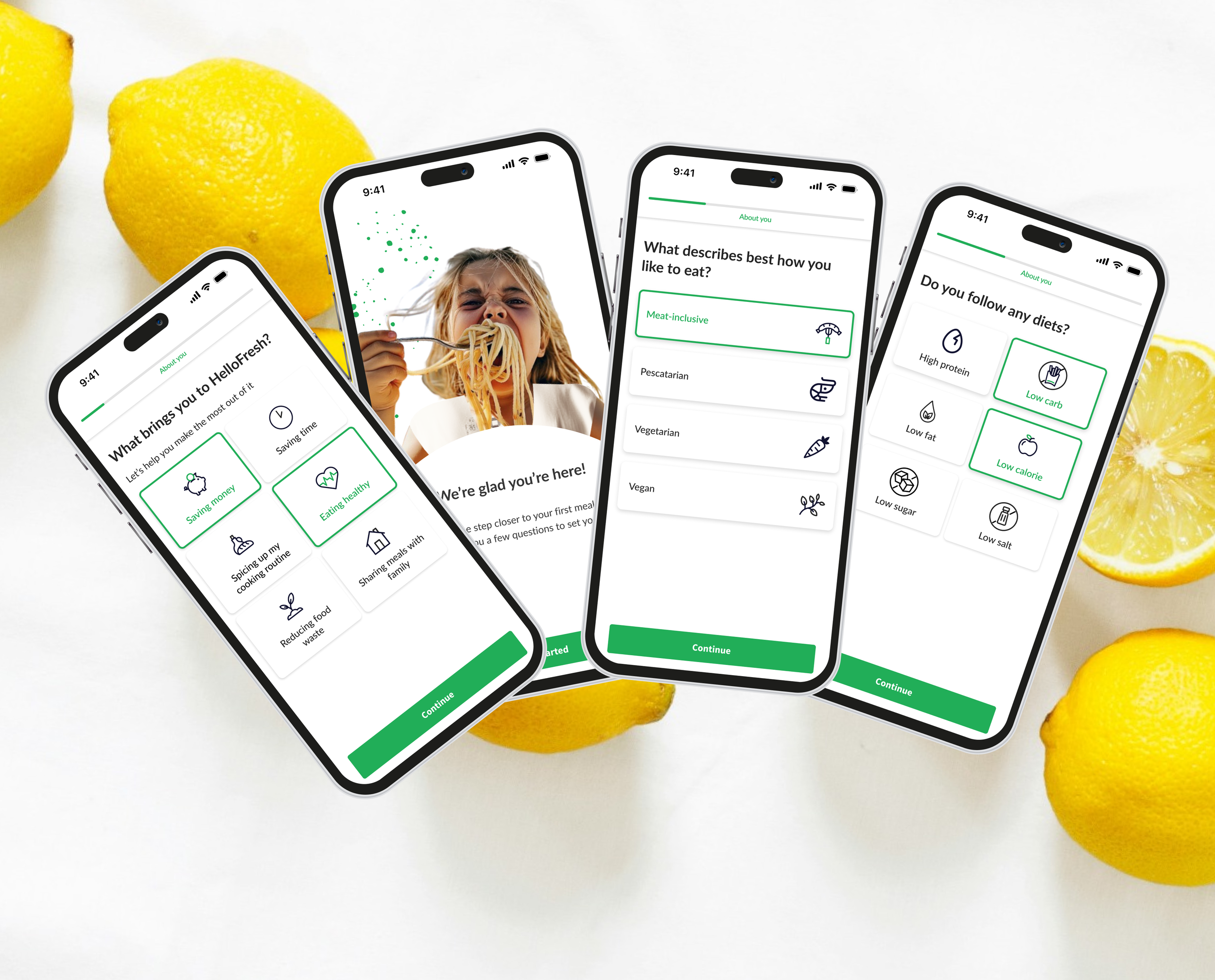
Problem Area






We observed significant drop-offs early in the prospective user journey.
Recurring survey feedback showed around 30% of prospective users were asking to select their meals before signing up.
When shared with stakeholders, this raised concerns: would early meal access hurt conversion?
Rather than act on the surface request, we conducted in-depth interviews with prospective users to explore the user mindset behind it.
The research revealed that the real barrier wasn’t meal choice itself, but users lacking confidence in dietary and lifestyle compatibility.
not about early meal selection
Low confidence in diet & lifestyle fit
Building strategy
This insight reframed the problem: the goal wasn’t to control meal selection, but to help users feel confident that HelloFresh fits their lifestyle early in their journey.
We held brainstorming sessions around: "How might we help users feel confident in our menu and product?"
By bringing in cross-functional perspectives, we explored seamless ways to support diverse dietary and lifestyle needs.
From these explorations, we defined a clear direction:
Empower users by asking the right questions


Recognizing the impact of early user input, we identified a broader opportunity: using these signals to inform personalization across the full customer lifecycle. By aligning with product partners, we balanced short-term acquisition wins with long-term personalization strategy.
Iterations
Based on our direction ‘empower users by asking the right questions’, we shaped our core hypothesis as: Asking the right questions at the right time could increase user confidence and reduce drop-offs.
Initial A/B tests validated the core hypothesis and delivered a positive business impact. They also helped address stakeholder concerns about adding friction to the early funnel.
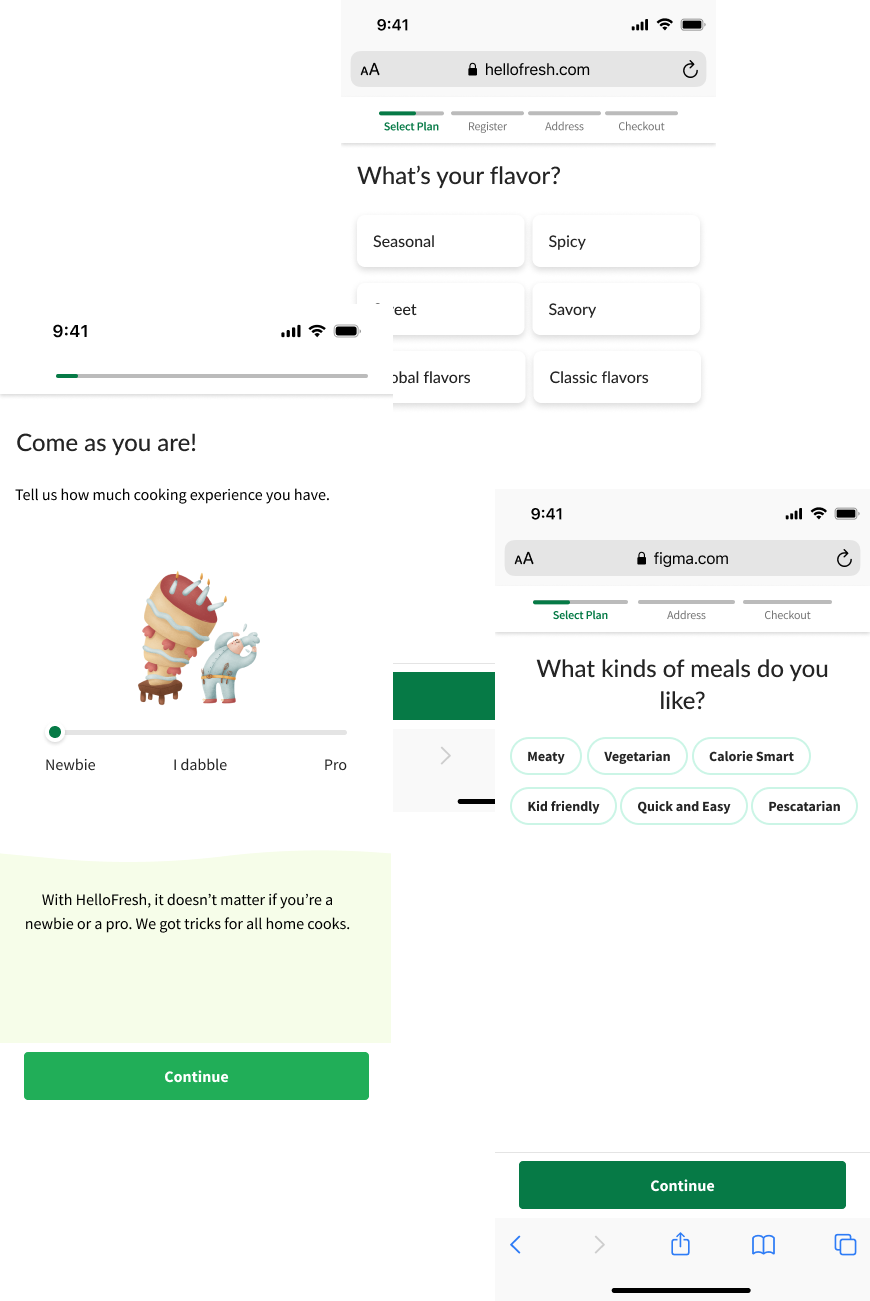
We noticed that the transition moment, after user share their preferences, can reinforce reassurance in the product fit. Yet, the A/B test didn’t confirm it.
This was a good reminder that reassurance isn’t universal, timing matters more than intent.

We then moved beyond pure validation, defined confidence signals, designed alternative questions, flows & UI variations.
We tested each change via rapid A/B experiments, and helped us refine our UI direction and confidence signals that belong in the early funnel experience.
Not every confidence signal performed as we expected.

Iterations confirmed the direction. The remaining friction wasn't structural, but lived within the selection component itself.
Reducing friction through clarity
Small-scale user studies revealed that the issue was not structural complexity, but visual noise within the selection component itself. We focused on refining the component to support users’ primary goal: confidently identifying the right plan.
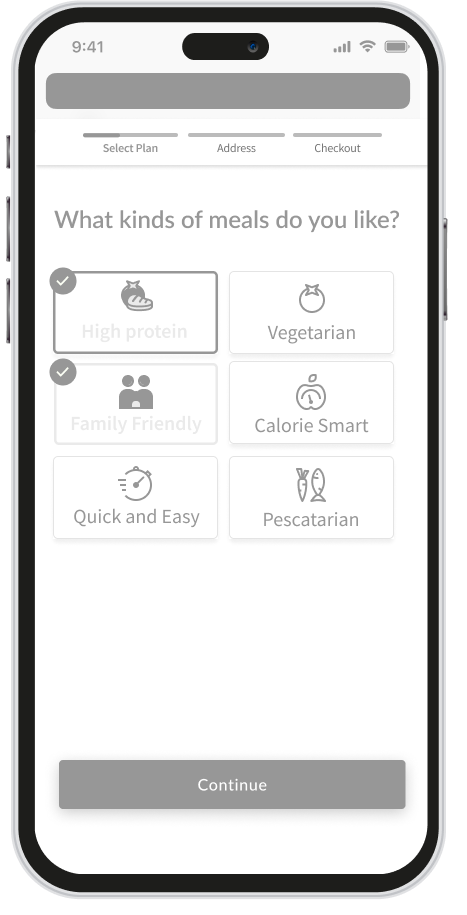
New UI component evoking confidence through clarity with
reduced competing visual signals
simplified iconography to improve scanability
built a modular and scalable component for system reuse
The original component had multiple visual indicators that distracted users and reduced clarity, taking focus away from their core goal: finding the right plan.
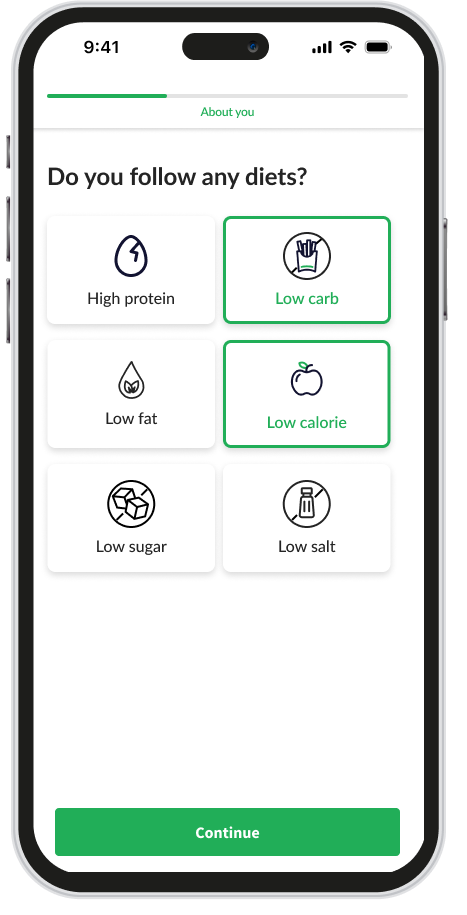
A/B testing confirmed improved clarity and plan selection progression, and the component was integrated into the design system for cross-market reuse.
Solution

We expanded the early plan selection experience to surface dietary and lifestyle fit signals, helping users build confidence before committing.
By using early user input to guide the journey, we presented more relevant options, reduced uncertainty, and supported confident plan selection.
UI visuals have been modified and anonymised to protect confidential work.
The interaction patterns and design decisions shown reflect the shipped experience.
Adoption
By addressing uncertainty around dietary and lifestyle compatibility, the redesigned experience helped prospective users progress toward a confident decision earlier in the journey.
Follow-up surveys showed a measurable decrease in menu-related uncertainty, reinforcing that confidence was the key lever in early decision-making.
As teams recognized the value of collecting structured user input early, the approach expanded beyond acquisition into a broader personalization strategy across prospects, active users, and reactivation journeys.
€53M+
in revenue
16
countries
3
brands